
The Rationality of Share Repurchases: Lessons in Capital Allocation
When examining the landscape of corporate leadership, it is hard to find a better subject for study than Henry Singleton. For investors and CEOs alike, his tenure remains a masterclass in capital allocation. His approach was, in the end, 100% rational—a statement that can be accurately made about very few corporate leaders.
A core component of this rationality, and a subject that remains deeply fascinating, is the stock repurchase. The fundamental rule of share buybacks is remarkably simple, yet it is consistently ignored in today’s market.
The Proof in the Numbers
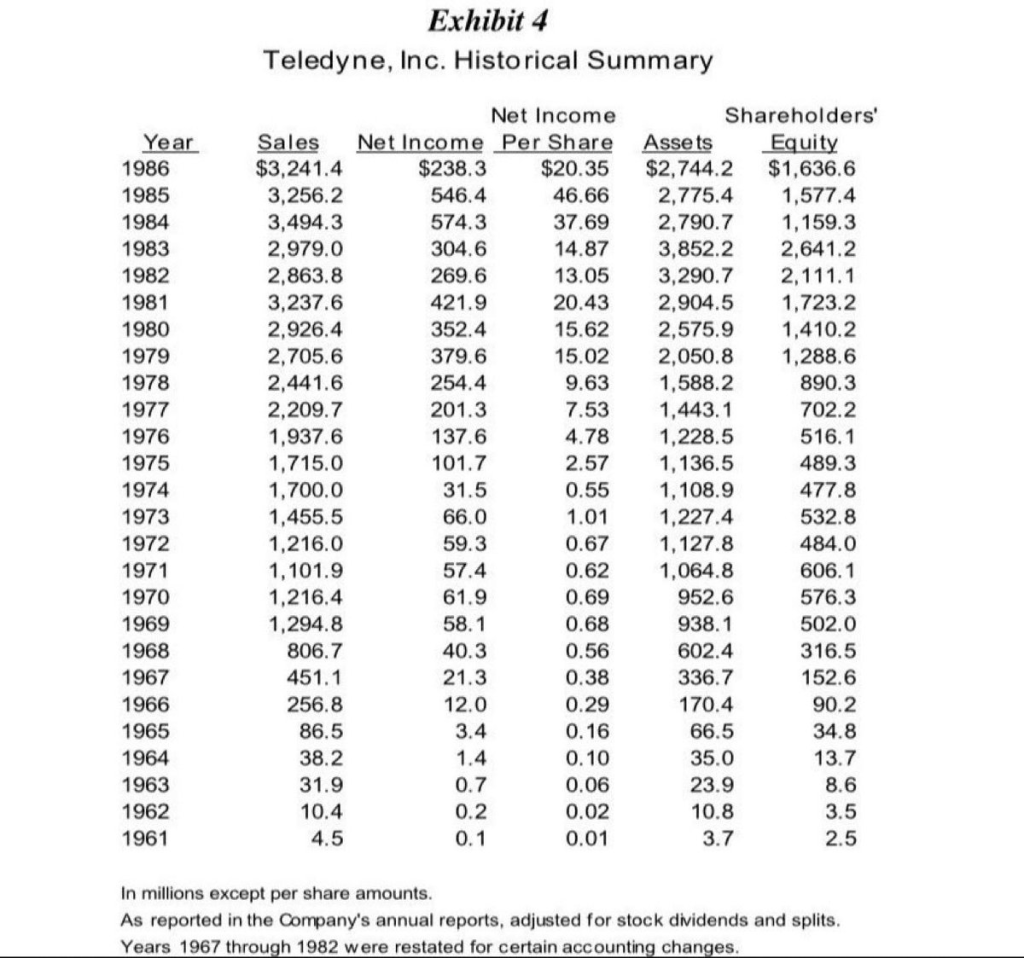
The mathematical proof of Singleton’s value creation is laid bare in the historical financials below: between 1972 and 1984, while Teledyne’s total net income grew by roughly 10-fold (from $59.3 million to $574.3 million), its net income per share exploded by an astonishing 56-fold (from $0.67 to $37.69) because he systematically repurchased the company’s stock when it traded well below intrinsic value. During this 12-year period, Singleton retired over 80% of Teledyne’s outstanding shares.
The period between 1972 and 1984 is highlighted because it represents the exact window when Henry Singleton executed one of the most aggressive and mathematically successful share repurchase programs in corporate history.
The Simple Math of Intrinsic Value
The golden rule of repurchases is absolute: You do it when you are buying dollar bills at a clear-cut and significant discount, and only then.
Specifically, it only makes sense for a company to repurchase shares when its stock is trading at a meaningful discount to a conservatively calculated intrinsic value. Warren Buffett summarized this perfectly when defending the practice, noting that anyone who claims all repurchases are inherently harmful is “either an economic illiterate or a silver-tongued demagogue”.
The math is straightforward: if a company repurchases shares at a discount to intrinsic value, the remaining shareholders’ interest in the business goes up without them having to lay out a single dollar. But the reverse is equally true—value is actively destroyed when purchases are made above intrinsic value.
As a general observation, most companies that repurchased shares thirty years ago were doing it for these right reasons. Today, however, the script has flipped.
The Illusion of Offsetting Stock-Based Compensation
Time after time, we see management teams initiating buybacks not because the mathematical discount is undeniable, but because they are attempting to be fashionable or subconsciously hoping to prop up their stock price.
Even worse is the modern trend of using corporate cash to offset the extreme dilution caused by excessive stock-based compensation (SBC). Today, many companies issue exorbitant amounts of stock to executives and employees, and then funnel massive amounts of shareholder cash into buybacks simply to keep the outstanding share count flat.
This is not a return of capital to shareholders; it is a stealth wealth transfer from outside investors to insiders. Because executive pay is now so heavily skewed toward stock-based instruments, management teams are heavily incentivized to authorize buybacks that absorb their newly printed shares and drive up prices in the short term. When a company uses its cash just to sop up the dilution it created for its own management, it diverts capital away from productive investments and true, long-term shareholder returns.
Praising by Name
When executed rationally, however, buybacks remain an incredibly powerful tool for compounding wealth and concentrating portfolio value. Loews is a great example of a company that has historically repurchased shares for the right reasons, guided by a strict adherence to intrinsic value rather than market sentiment.
It would be easy to list examples of companies currently doing the exact opposite, destroying shareholder value to mask their compensation packages. But in the spirit of a well-worn and wise dictum: it is always better to praise by name, and criticize by category.
For those of us looking to allocate capital effectively, the lesson is clear. Seek out the rare, 100% rational managers who understand the difference between a true discount to intrinsic value and a market illusion.
Our Approach
At Franklin Watson Investments, we have invested in several businesses that are actively repurchasing shares and creating real value for our partners. Some of the companies in our concentrated portfolio have repurchased over 10% of their outstanding shares in the last year, and approximately 15% over the last two years.
The mechanics of how this creates value for our partners are straightforward. When a company retires 15% of its shares at a discount, our proportional ownership of the business automatically grows. We acquire a larger claim on the company’s assets and future cash flows without deploying any additional capital.
More importantly, it mathematically supercharges our earnings. Even if a company’s absolute net income remains completely flat, shrinking the share count (the denominator) means the Earnings Per Share (EPS) actively increases. By consistently buying dollar bills at a discount, these management teams are concentrating our share of the profits and permanently increasing the intrinsic value of every share we hold.

